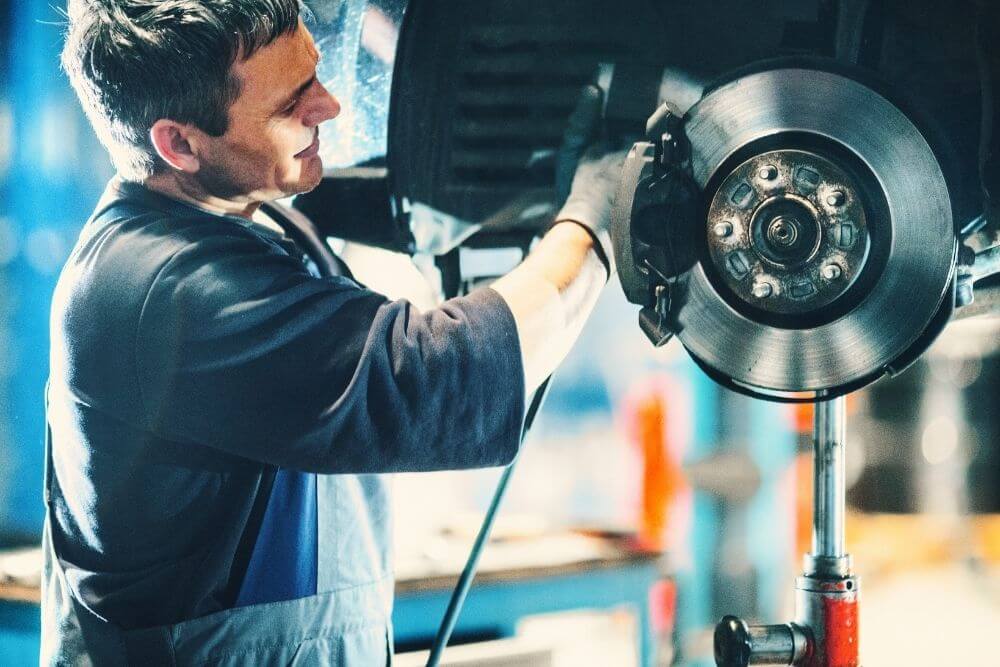
If you’ve ever hit the brakes and felt the pedal “thump-thump-thump” back at your foot, you already know how unsettling brake shudder can be. A lot of drivers immediately assume one thing: “My rotors are warped, I need new ones.”
The rotor needs replacement in some cases. The rotor can be secured through safe procedures, which restore smooth braking function to the system without requiring new components.
This statement requires clarification because warped rotors require treatment to eliminate operational problems, which decrease braking confidence and lengthen actual stopping distances and lead to faster pad and suspension component deterioration. Continue reading to learn more about the meaning of “warped” together with its causes and methods for determining its existence and guidelines for deciding between resurfacing and replacement as your best option.
What People Mean When They Say “Warped Rotors”
Most of the time, “warped rotors” is a catch-all phrase for brake vibration. In reality, the most common issue is uneven rotor thickness (often called DTV: disc thickness variation) or runout (the rotor doesn’t spin perfectly true).
Both problems can create the same feeling:
- Pulsation in the brake pedal
- Shaking in the steering wheel, especially while braking at highway speeds
- A rhythmic vibration that gets stronger as you slow down
True rotor warping (where the metal actually deforms like a bent record) can happen, but it’s less common than people think. What matters for you as the driver is this: if the rotor surface is no longer uniform, you’ll feel it, and the braking system will not behave as smoothly as it should.
The Most Common Signs Of A Warped Rotor
Brake issues can overlap, but these are the classic symptoms tied to rotor thickness variation or runout:
1) Pulsating brake pedal
This is the big one. You press the pedal, and it pushes back in a steady rhythm as the wheel rotates.
2) Shaking steering wheel or vehicle vibration
If the front rotors are the problem, you’ll often feel it in the steering wheel. Rear rotor issues may feel more like a vibration through the seat or the whole vehicle.
3) Grinding or squealing noises
Noise can come from several sources, but warped rotors sometimes go hand-in-hand with uneven pad wear, glazing, or metal-to-metal contact if the pads are worn out.
4) Brake shudder (especially on long stops)
If the shudder gets worse after repeated braking, heat is likely part of the story.
Why Do Rotors Get “Warped” In The First Place?
Warped rotor symptoms usually show up because something caused uneven wear or uneven transfer of pad material onto the rotor face.
Here are the most common causes.
Excessive heat and improper cooling
High-temperature conditions develop during hard braking and towing, mountain driving, track use, and repeated stop-and-go traffic situations. The rotor develops hot spots and surface changes, which result in vibration when it reaches high temperatures and cools down in an uneven manner.
Improperly torqued lug nuts
This one is more common than most people realize. If lug nuts are over-torqued, under-torqued, or tightened unevenly (for example, hammered on with an impact gun), the rotor can be clamped unevenly against the hub. That can create runout, which can later “wear into” thickness variation.
Worn-out or low-quality brake pads
Pads that are near the end of their life, or pads that don’t handle heat well, can cause uneven contact and deposits. If the pad material transfers unevenly, the rotor surface becomes inconsistent, and you feel it as pulsation.
Pad imprinting (uneven pad deposits)
After heavy braking, if you come to a stop and keep the brake pedal clamped firmly while the rotor is extremely hot, the pad can “print” material onto one spot on the rotor. That small patch can be enough to trigger a shudder during future braking.
So, Can Warped Rotors Be Fixed?
Yes, sometimes. The fix depends on two things:
- How severe the variation/runout is
- How much usable rotor thickness is left
There are two common “fix” paths:
- Resurfacing (machining) the rotor
- Replacing the rotor
Let’s break down how to decide.
When Resurfacing Warped Rotors Makes Sense
The resurfacing process, which machining or turning operations use, removes a thin metal layer from the surface to create a smooth braking surface. The process becomes effective when the problem is small, and the rotor maintains enough thickness to allow safe functioning after machining.
Resurfacing is usually a good option when:
- The pulsation is mild to moderate
- The rotor has no cracks
- There are no severe heat spots or obvious hard areas
- The rotor will still be above the minimum thickness after machining
- The rotor surface is generally solid, just uneven
The key rule: minimum thickness matters
Every rotor has a minimum thickness specification (often called “MIN TH” cast into the rotor hat or listed in service data). If the rotor is at or below that limit, it should not be resurfaced.
Even if a shop can machine it, a too-thin rotor:
- Dissipates heat worse
- It is more likely to overheat and distort again
- Can crack more easily under stress
A reputable shop will measure the rotor before and after machining. If they don’t measure, you’re gambling.
On-car vs. off-car machining
Some shops use on-car brake lathes that can reduce vibration caused by hub-related runout. Off-car lathes can still work well, but the rotor and hub mating surfaces must be very clean, and the rotor must be installed correctly afterward.
When Warped Rotors Should Be Replaced (No Debate)
There are several situations where replacement is the better call, and in some cases, the only safe one.
Replace the rotors if:
1) The rotor is below minimum thickness (or will be after resurfacing)
This is the most straightforward reason. If it’s too thin, it’s done.
2) The rotor is severely warped, or the vibration is strong
If the shudder is aggressive, resurfacing may remove too much material, or it may not correct the problem for long. Severe runout can also point to hub issues, bearing issues, or a rotor that’s been heat-damaged.
3) There are cracks, heavy scoring, or chunks missing
Cracks are an immediate replacement situation. Deep grooves can sometimes be machined out, but only if the thickness remains safe and the rotor surface can be restored properly.
4) The rotor has hard spots from extreme heat
Hard spots (localized heat damage) can cause persistent pulsation and uneven braking even after machining. In these cases, replacement is usually recommended because the rotor’s structure has been compromised.
5) You’re already doing a pad replacement, and the rotors are borderline
Pads bed into the rotor surface. Putting fresh pads on a questionable rotor often leads to noise, uneven wear, and the same pulsation coming back quickly. If the rotor is near its limit or has clear heat damage, replacement typically saves money and frustration long-term.
What About “Just Replacing Pads” To Fix The Shudder?
New pads alone rarely fix a rotor-related pulsation. If the rotor surface has a thickness variation, the pads will still follow that uneven surface. You might feel a small improvement if the old pads were damaged or glazed, but the underlying issue usually remains.
If you’re chasing brake shudder, the rotor needs to be measured and inspected, not guessed at.
How A Shop (Or A Serious DIY Era) Confirms The Problem
To make the right call between resurfacing and replacement, you need measurements, not vibes.
A proper inspection often includes:
- Measuring rotor thickness with a micrometer in multiple spots
- Checking disc thickness variation
- Measuring lateral runout with a dial indicator
- Inspecting for heat checking, cracking, glazing, and scoring
- Checking hub surface cleanliness and rust buildup
- Confirming lug nuts were torqued properly and evenly
Sometimes, what feels like a warped rotor is actually:
- Rust or debris between the rotor and hub is causing runout
- A sticking caliper is causing uneven pad deposits
- Worn suspension components amplify braking vibration
A good diagnosis prevents you from buying rotors when the real issue is elsewhere.
How To Prevent Rotors From Warping Again?
If you fix the rotors but don’t fix the cause, there’s a good chance the vibration returns.
Here are the habits and checks that actually help:
Torque lug nuts properly
Use a torque wrench and tighten in a star pattern. Uneven torque is a repeat offender for rotor runout.
Avoid holding the brakes after hard stops
The first sentence brings the brake force to a halt because it requires you to maintain brake pressure while your vehicle exhausts all accumulated heat through its systems. The first sentence establishes safe stopping procedures, which require light brake application or parking brake usage according to your vehicle’s manual, because you should not stop for extended time periods.
Replace worn pads early
Letting pads wear down to nothing increases heat and can damage the rotor quickly. Quality pads also help manage heat and reduce uneven transfer.
Make sure calipers slide freely
Sticking slide pins or a dragging caliper can overheat one side and create uneven deposits.
Bed-in pads properly
Many pads benefit from a proper break-in procedure to create an even transfer layer on the rotor. Skipping this can lead to uneven deposits and shudder.
Does Rotor Quality Matter?
Yes. The combination of rotor metallurgy and cooling design, together with manufacturing quality, determines the effectiveness of heat management and the lifespan of components. The existence of hot spots and rapid material degradation through uneven wear patterns will render a perfect installation useless once you install low-quality components.
Choosing tested brake components will get you dependable braking power, together with extended service life for your brake rotors. Professional brake repair services like ours here at our auto repair shop we help prevent early component damage when installed and maintained according to established procedures.
The Simple Answer: Fix VS Replace
Here’s the practical rule you can use:
- Fix (resurface) the rotors if the warp is minor, the rotor is in good condition, and it will stay above minimum thickness after machining.
- Replace the rotors if they’re thin, severely warped, heat-damaged (hard spots), cracked, or if resurfacing would push them below spec.
If you’re not sure, ask the shop for the measurements. A trustworthy tech can show you rotor thickness readings and explain whether machining is safe.
Choose Maclane’s Automotive
Pay attention to the common signs that indicate rotor warping because they require your attention! The good news is that warped rotors can often be fixed, but only when the rotor is still thick enough and not heat-damaged. Resurfacing enables smooth braking restoration, meaning greater cost savings. A good solution calls for replacement when the rotor has extreme warping, which causes it to fall below standard specifications, or if it has suffered damage from extreme heat.
Our services aim to achieve three things, including restoring brake performance, eliminating vibration issues, and establishing permanent repair solutions through defect elimination. Give us a call today at (610) 981-2183 for professional brake repair in Downingtown, PA, and get your brakes back up and running right!
