
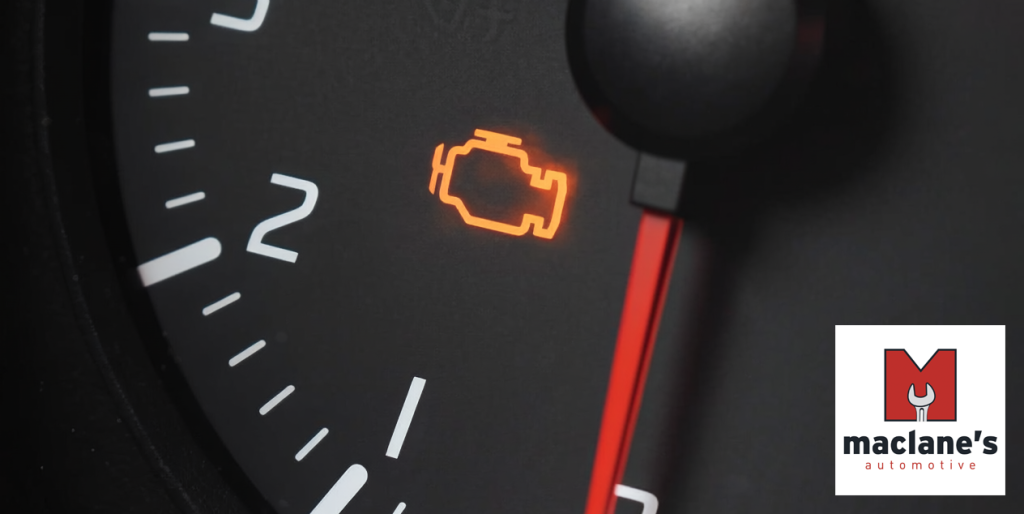
A check engine light that turns itself off can make a driver feel a little silly. Yesterday it was a problem. Today, the dashboard looks normal. So… do you ignore it?
Not always. At Maclane’s Automotive in Malvern, PA, we hear this exact story a lot. The light came on after getting gas, during a cold start, in heavy rain, or on a long drive. Then it vanished like nothing happened.
The vehicle is not being dramatic. The computer saw something. It just may not be seeing it right this second.
What It Means When The Light Turns Off
Modern vehicles test themselves constantly. When a reading falls outside the normal range, the computer can store a code and turn the light on. If the problem does not repeat for a few trips, the light may turn off.
That does not always clear the history. Many times, the code is still sitting there, along with a snapshot of what was happening when the fault showed up.
The Gas Cap Possibility
Yes, the gas cap really can do it. If the light came on soon after filling up, a loose cap or worn seal may have triggered an EVAP code. Tighten it, drive a bit, and the light may shut off after the system retests.
Simple problem. Still worth checking if it keeps happening, because a cracked seal or small vapor leak can come back again.
Intermittent Problems Are The Tricky Ones
Some issues only show themselves under the right conditions. A weak coil may act up under load. A misfire may show up in wet weather. A small EVAP leak may only fail the test when the fuel level and temperature are just right.
That is why “the light is off now” does not always mean much. If the car shook, hesitated, smelled odd, or felt low on power, pay attention to that memory.
Sensors And Voltage Can Play Games Too
A scan gives us a place to start, but live data and testing tell us whether the part is actually bad or whether something else is fooling the computer.
Do Not Ignore A Flashing Light
If the check engine light flashed, even for a short time, do not brush it off. A flashing light often points to an active misfire, and that can damage the catalytic converter.
Rough idle, stalling, poor acceleration, hard starts, fuel smells, overheating, or worse gas mileage are also good reasons to schedule a diagnostic.
Why A Scan Still Helps
A scan can show whether the code is stored, pending, current, or recently cleared. It can also help with emissions readiness. Clearing codes or waiting too long can make the useful information harder to find.
If your check engine light went off by itself, call Maclane’s Automotive in Malvern, PA, at (484) 321-8137. We will pull the codes and explain what the vehicle actually saw, not just guess at a sensor.