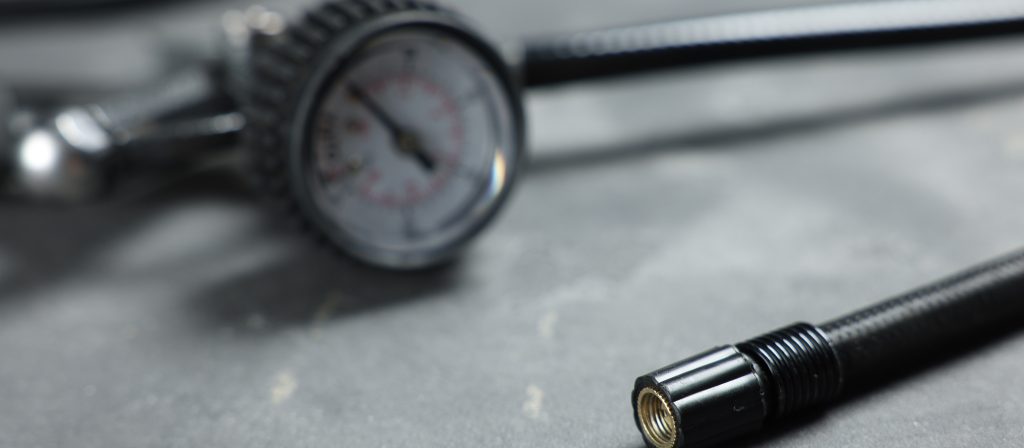
There’s a difference between a gauge that repeats itself and one that’s right. Yours might give the same number all afternoon and still be off. Unfortunately, putting it beside another untested gauge doesn’t quite settle that. You need something of known accuracy to compare it against.
Before you throw yours away, though, we’d check a few less expensive explanations. Bring it with you to Maclane’s Automotive if the readings have been puzzling. It’s a small thing to toss in the car, and much more useful than trying to remember the numbers afterward.
Start Over On A Parked Car
Leave the car parked for at least three hours, then try a reading before you drive. The tires are cold in the maintenance sense, even on a warm day. This is the condition the vehicle’s pressure recommendation is written for. If you drove to an air pump between measurements, the higher reading there could simply involve warmer tires.
The gauge has to sit squarely on the valve, too. You shouldn’t be listening to a continuous hiss while trying to read it. Reseat it if you are. Take another reading, but don’t keep releasing little bits of air through endless attempts. At some point the testing itself changes what you’re measuring.
Have A Look At The Gauge
Has it taken a fall onto the driveway? Does the sliding bar catch? Is the hose on a dial model split? For a digital one, how old is the battery? We’d check those things and the maker’s instructions before deciding it’s the tire doing something strange.
A cheap gauge isn’t automatically bad, and a fancy one isn’t immune to damage. Its stated accuracy and usable range matter. The gauge for your car should suit the pressures you’re checking; buying the one with the biggest number on the dial isn’t much of a selection method.
Ask What You’re Comparing It With
The air-station hose has probably had a fairly rough life. We’d use it as another observation, not declare it the winner. The car’s display may also be working from an older sensor reading. A comparison needs current measurements under similar conditions or you’re mixing several questions together.
For a proper accuracy assessment, ask about a reference instrument with known accuracy at the pressures you use. One matching point won’t establish accuracy everywhere on the scale. Don’t assume a shop comparison is a formal multi-pressure calibration service; ask what can actually be checked.
Then Decide Whether To Keep It
Some gauges can be adjusted according to their manufacturer’s instructions; others are better replaced. We’d be wary of a damaged tool you’re keeping alive by remembering to subtract a little every time. A clean, protected storage spot helps the replacement avoid the same treatment.
Use the vehicle’s door placard or manual for its cold-pressure setting, rather than the tire sidewall rating. Don’t bleed warm tires down to that cold number. And if a tire keeps losing air, that needs investigation even if the gauge was questionable too. Call Maclane’s Automotive in Downingtown, PA at (610) 822-9956 and we’ll help you work through the readings and the tire concern.
