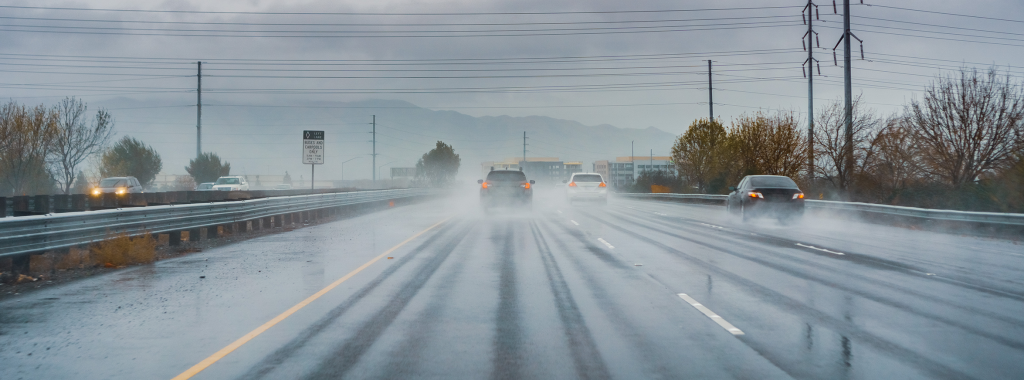
Have you ever been cruising along with a rain shower when your vehicle suddenly seems to lose contact with the surface of the road? When your steering wheel is unresponsive, it is easy to freeze with fear as you notice you’ve lost control. This scary scenario is classic hydroplaning, arguably the most precarious driving situation motorists encounter on rainy days and monsoon weather.
Hydroplaning occurs when there is a sheet of water over the road and beneath your tires, so your vehicle is actually surfing on water instead of maintaining safe contact with the road! This loss of traction takes only seconds and can make an otherwise ordinary drive into a potentially fatal ride.
Regardless of whether you’re driving through the erratic autumn weather or wading through the heavy autumn rains, having a knowledge of how to drive safely on rainy roads isn’t only practical, it’s vital to any driver on the road. Far too often, whether you’ll ever arrive at your destination safely or end up as a mere accident statistic depends on knowing how to prevent and recover from hydroplaning conditions.
Understanding Hydroplaning
Hydroplaning, or “aquaplaning”, is when the tires on your car become detached from the road surface due to water building up between them. This results in a dangerous situation in which your tires are “surfing” over water instead of sticking to the road and losing significant traction.
The physics of hydroplaning are simple: when more water than your tires can remove to the outside along their grooves builds up on the road, the water doesn’t know where to go. Your tires start floating above this layer of water, eliminating the critical rubber-to-asphalt contact that allows you to maintain control of your car.
Key Contributing Factors
A few contributing factors combine to make hydroplaning more likely for you:
Excessive speed: Traveling over 35 mph leaves your tires with not enough time to force water out of the way effectively
Shallow tread tires: Reduced tread reduces your tires’ capacity to drain water from the contact patch
Standing water: Deep puddles and accumulated water on the road provide ideal hydroplaning conditions.
Poor road conditions: Slick pavement, potholes, and sections where water is likely to accumulate
The Hidden Danger of Contaminants
Motor oil and other automotive fluids create a very deadly mixture when mixed with rainwater. In the first few minutes of light rain, these contaminants rise to the surface, creating a thin film slick that greatly reduces tire traction even before large areas of water accumulation occur. This silent danger will catch the majority of drivers off guard because the road may appear almost dry but very slippery.
Causes and Signs of Hydroplaning
Rain intensity is the most important factor to pay attention to when attempting to determine your likelihood of losing control on wet roads. Light rain can be harmless enough, yet the initial 10 minutes of rain produce some of the worst conditions. In those first few minutes, water combines with road oils laid down on the road, dust, and debris to make an extremely slippery surface that tends to surprise drivers.
Rain torrents have some issues of their own. As soon as the force is greater than your tires can push water aside, you are hydroplaning. The harder it rains, the less time the water has to run off the road, and highway standing puddles result in immediate traction loss.
Recognizing the Warning Signs
You’ll know hydroplaning is occurring when:
- Your steering wheel feels unusually light or unresponsive
- The engine RPMs suddenly increase without acceleration
- Your vehicle feels like it’s floating or drifting
- You notice a lack of road noise from your tires
Tire tread depth serves as your first line of defense against these conditions. New tires typically feature 10/32″ to 12/32″ of tread depth, with grooves specifically designed to push water away from the contact patch. When tread depth drops below 4/32″, your tires lose much of their water displacement capability.
Tread depth correlation with wet surface performance is not linear; it is exponential. The tires, which have 2/32” of tread remaining, have nearly 50% less traction on wet pavement compared to tires that are at 4/32”. This huge degradation in performance is the reason why having enough tread depth becomes required to achieve safe driving in the rain.
Tips to Prevent Hydroplaning Accidents
The best method of preventing dangerous hydroplaning conditions is prevention. By having safe driving habits and employing good vehicle control practices, you can minimize your risk of hydroplaning on roads when there is water present. Do Not Use Cruise Control in Rain
Never use cruise control in the rain. If your bike hydroplanes with cruise control enabled, the system will continue to try to keep you at your set speed. That small pulse of acceleration will increase loss of traction and make it very hard to correct. Cruising on cruise control during rain doesn’t allow you to change your speed quickly, which is crucial for tire contact with the road.
Use manual mode and not cruise control.
This allows you to feel any deviation in how your car interacts with the road and react instantly to changing road conditions. Your gas pedal foot will give you continuous feedback in terms of degrees of traction that automatic systems just can’t come close to.
Learn Proper Braking Techniques
Apply smooth and controlled braking to prevent skids in the wet. If you feel your vehicle is about to lose traction, do not brake abruptly because this will cause loss of total control. Instead, apply steady and gentle pressure to your brake pedal by pumping in the event that you lack anti-lock brakes.
For new cars with ABS, use firm and steady pressure rather than pumping. The system will automatically lock up the wheels, but you must remain attentive and never slam on or brake hard, which will exhaust your tires’ capacity for contact with the road.
Double the space between you and the car ahead when you are driving in rainy weather. The added space provides time to decrease speed gradually rather than employing emergency brakes that result in hydroplaning.
What to Do If You Experience Hydroplaning?
The moment your vehicle begins to hydroplane, your response is what keeps you safe to get your vehicle back under control or lose complete control. It feels just like the car spinning out of control or skidding, and obviously, this alarms most drivers.
Stay calm and do not jerk the steering wheel. Jerking the steering wheel will only make things worse, and having your car spin like it has lost all its sense. Hold the steering wheel firmly in both hands and do not overcorrect.
Take your foot off the accelerator as quickly as possible. This lets your car slow down on its own without the added hazard of hard braking. Do not pump the brakes hard, as this will lock up your wheels and remove any remaining traction.
Steering Techniques During Hydroplaning
The solution to exiting hydroplaning is a good steering technique. Steer toward the skid – if your rear skids to the right, turn your steering wheel gradually to the right. The counterintuitive movement keeps your tires pointed in the direction of travel.
Make slow, smooth steering adjustments instead of large ones. Your aim is to enable your tires to reestablish contact with the asphalt surface, not battle the skid. Once you feel your tires grab onto the asphalt, you can start slowly aligning your steering wheel.
Apply light brake pressure with a pumping action if you need to slow down even more. This action prevents wheel lockup but still allows you to maintain some steering ability as your car regains traction.
Keeping Your Car Ready for Safe Driving on Wet Roads
Your car’s readiness is essential in evading hydroplaning accidents. Tire care instructions become even more indispensable when wet conditions push your car to maintain contact with the road.
Regular Tire Rotations
Rotating tires every 5,000 to 7,500 miles allows all four tires to be worn evenly. The front tires will last shorter due to steering and braking loads, with different patterns of stress for the rear tires. This servicing maintains uniform tread depth for all tires, which is directly related to your water evacuation ability from the contact patch.
Proper Tire Inflation
Proper tire pressure is also critical to excellent wet weather traction. Under-inflation loads the tire with excessive surface area onto the road, producing a lot of friction and limiting the tire’s water displacement ability. Over-inflated tires bow the center tread out and decrease the contact patch, thereby decreasing traction.
Check your tire pressure monthly with a good-quality gauge and always take the measurement when tires are cold in order to get correct readings. The recommended pressure from your vehicle’s maker is probably on a sticker on the driver’s door jamb or in your owner’s manual.
Tread Depth Monitoring
Correct tread depth enables your tires to push water away from the contact patch. Treaded-out tires tremendously heighten hydroplaning danger as they are unable to push water below the tire efficiently. Conduct the penny test or purchase a tread depth gauge to examine wear patterns on a regular basis.
Choose Maclane’s Automotive
In rainy weather, safe driving is about technique, car maintenance, and vigilance. What we’ve discussed—speeds in range for tires fully equipped, can be the difference between a smooth, safe drive and a fatal hydroplaning wreck.
How your car is performing is most critical when soggy roads are on the menu. If you start noticing some of these warning signs, it’s time to call in the experts:
Don’t wait until you hydroplane to have issues fixed. Downingtown, PA, auto repair shops are able to detect issues before they become safety hazards. Here at Maclane’s Automotive, our skilled technicians are kept occupied with detailing inspections of single vehicles, tire maintenance, and auto repair services that render you safe on wet roads.
Just remember, it always costs less to pay money for maintenance in advance than to fix up accidents. By maintaining your car properly and driving gently, you not only save your own life and your passengers’ lives, but you’re also doing the rest of us out there driving in bad weather a great big favor too.
- Unusual tire wear patterns
- Vibrations while driving
- Poor traction even in light rain
- Steering instability
Don’t wait until you hydroplane before issues are solved. Our expert mechanics at Maclane’s Automotive conduct thorough car checks, tire maintenance, and car repair services to make you a safe driver on snowy roads.
Just remember that money invested in preventative maintenance always costs less to fix than accidents do to repair. Defensive driving strategies and having your car in top working order are safeguarding yourself, your passengers, and the other drivers who just happen to be riding along with you on the road in inclement weather. Give us a call today at (610) 590-9974 to get your car back on the road if you’ve had an accident due to hydroplaning!
