A drive should not leave you constantly nudging the steering wheel to stay in your lane. Maybe the pull began after a pothole. Maybe it has crept up slowly enough that you barely noticed until someone else drove the car. Either way, it is worth finding the cause.
At Maclane’s Automotive on Horseshoe Pike, PA, we check pulling complaints before assuming a wheel alignment is the answer. Alignment can be responsible, but a tire, dragging brake, or loose suspension part can produce a similar feeling. Adjusting the wrong thing just sends you back onto the road with the same problem.
When Does The Car Pull?
That is one of the first questions we ask. Does it happen all the time, only at speed, or just when you brake? Did it begin after new tires, a rotation, or suspension work? You do not need the technical name for the fault. A clear description of what changed gives us somewhere useful to start.
Roads are usually sloped to drain water, and that slope can cause some drift. Wind can affect the car too. A persistent pull on different roads, a sudden change, or a steering wheel that sits crooked deserves a closer look.
Do not let go of the wheel to test it. Keep control of the vehicle and leave diagnostic road testing to the shop. If the pull is severe, the steering feels loose, or braking becomes unpredictable, stop somewhere safe and arrange a tow.
What A Wheel Alignment Can Correct
Alignment describes the angles at which the wheels sit and travel. Camber is the inward or outward tilt viewed from the front. Caster relates to the steering axis viewed from the side. Differences across the front axle can contribute to a pull.
Toe describes whether the tires point slightly toward or away from one another. Incorrect toe often shows up as tire wear, wandering, or an off-center steering wheel. It is not helpful to blame every steady pull on toe alone.
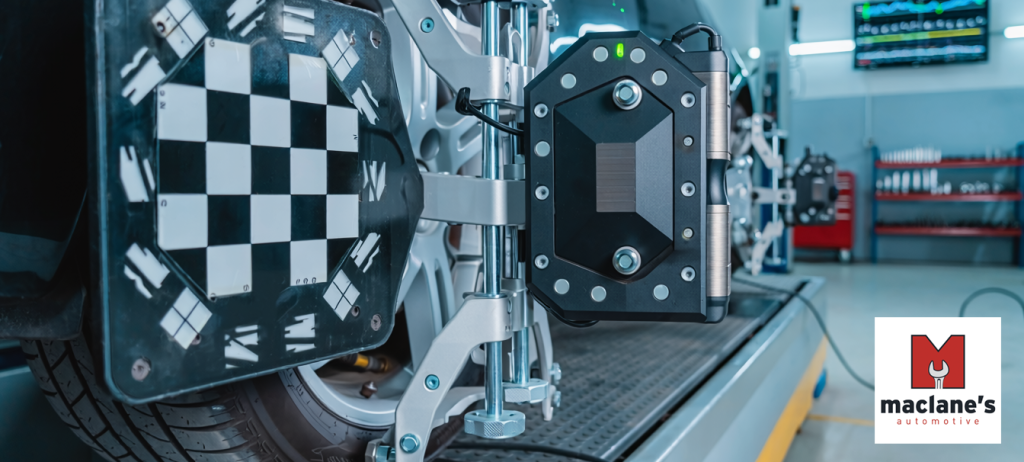
We measure the relevant angles against the vehicle’s specifications. Rear alignment matters as well; the rear wheels influence the direction the vehicle wants to travel. Some angles have no routine adjustment, so an out-of-spec reading may call for inspection of a worn, bent, or shifted component rather than another turn of an adjuster.
Check The Tires Before Chasing The Numbers
One low tire can change how the car tracks. We check cold pressures against the vehicle placard, not the maximum pressure molded into the sidewall. Then we look at tread wear, tire sizes, condition, and whether the tires belong together on that vehicle.
A tire can cause a pull even when the alignment readings are within specification. Internal construction and wear can create a sideways force as it rolls. Where the tire type and wheel fitment allow, a controlled tire-position change can help isolate that. Directional or staggered tires require a different approach; swapping the front tires side to side is not a blanket home test.
If the pull started immediately after a rotation or new tire installation, tell us. That timing can save a lot of unnecessary adjustments.
Loose Parts Do Not Hold An Alignment
A worn tie rod, ball joint, or control arm bushing can let a wheel move under load. A static measurement does not tell the whole story when a part shifts as you brake or steer. Wheel bearings and other suspension components also need checking where the symptoms point.
Clunks over bumps, vague steering, uneven tire wear, and vibration are useful clues. They do not identify a single failed part, but they help guide the inspection.
If a component needs repair, we address it before the final alignment. There is little value in carefully setting angles around a joint that cannot hold the wheel steady.
A Pull Under Braking Changes The Priorities
If the car travels straight until you press the brake pedal, we pay close attention to the brakes. Unequal braking force from a sticking caliper, restricted hose, contaminated friction surface, or other fault can tug the car sideways.
A vibration or pulsing pedal is a separate clue and may accompany the complaint. It still needs diagnosis; a brake pull is not automatically a warped rotor, and an alignment does not repair a sticking caliper.
Do not keep driving through a strong brake pull or a burning smell. A wheel may be dangerously hot, so avoid touching it. Get the vehicle safely off the road and arrange help.
Find The Cause Before Buying The Fix
We use the symptoms, a road test when safe, tire checks, component inspection, and alignment measurements to work out what the car needs. Sometimes that is an alignment. Sometimes a tire or brake repair comes first.
Call Maclane’s Automotive on Horseshoe Pike, PA, at (610) 590-8669 if your car is pulling, wearing tires unevenly, or leaving you with a crooked steering wheel. We will help you understand what is causing it and what needs to happen to get the car tracking properly again.