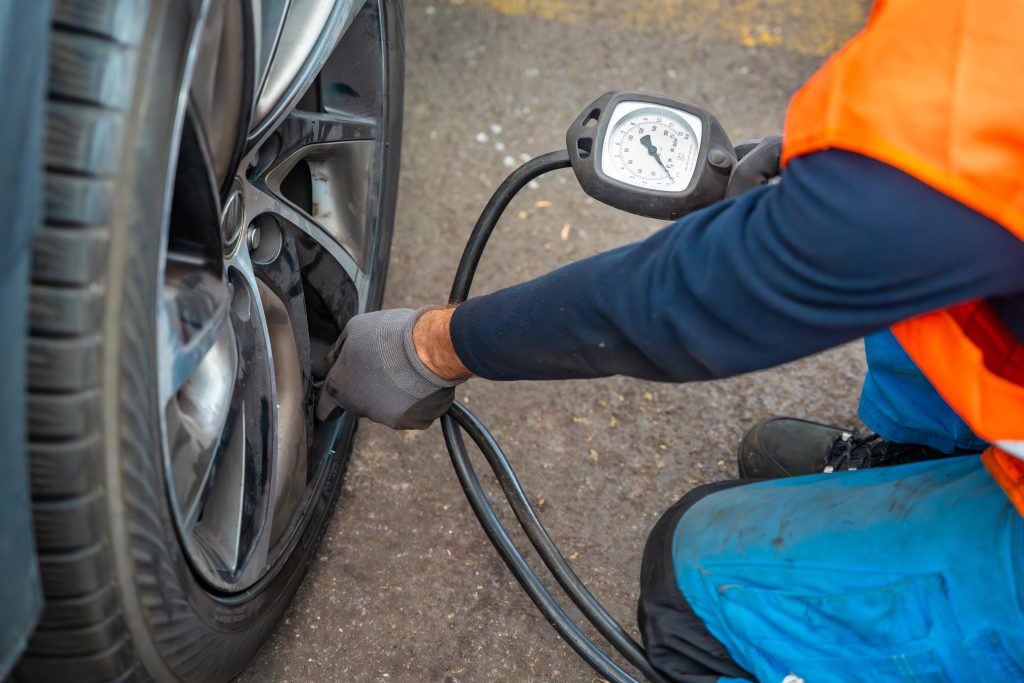
Same tire. Same warning. You’ve already put air in it this week, and now it wants more. Before you order a replacement, let us find the leak. At Maclane’s Automotive in Downingtown, PA, we can check whether tire repair is an option. A leak doesn’t automatically condemn the tire, but holding air after a quick plug isn’t proof that it’s safe either.
Where Is The Air Going?
A screw in the tread gives you something obvious to point at. Other leaks take more looking. The valve may be leaking, or air may be sneaking past the bead, which is where the tire seals against the wheel. Corrosion on that surface can spoil the seal. The wheel itself can be damaged too.
Cold weather can bring pressures down across the set. One tire that keeps losing more than its neighbors is a different matter. We’d want to find out why, even if there’s nothing visibly wrong with it. Another stop at the air pump won’t answer that question.
The Tire Comes Off Before We Decide
For passenger and light-truck tires, a puncture generally has to be within the designated tread repair area and no bigger than 1/4 inch across. That’s only the starting point. We also have to follow the tire manufacturer’s restrictions. A small hole too close to the shoulder can still mean no repair. So can overlapping repairs or damage on the inside.
That last part matters. You can’t inspect the inside with the tire still mounted. Once it’s off, we can see whether it has damage that wasn’t apparent from the driveway. An acceptable permanent puncture repair fills the hole and seals the inner liner, often with a combination patch-plug. A rope plug pushed through from outside doesn’t do the whole job.
Tell Us If You Drove On It Low
It’s tempting to leave out that short drive with the tire nearly flat. Please tell us anyway. A nearly flat tire flexes in ways it shouldn’t as it rolls, sometimes damaging the sidewall from within. Air can’t undo that. Even an approximate distance helps us, so don’t worry if you can’t remember the exact mileage.
We can’t patch away a bulge, exposed cords, internal separation, or a sidewall or shoulder puncture. Those mean replacement. Tread and age matter as well; there isn’t much point fixing a hole if the rest of the tire is finished.
Sometimes The Tire Isn’t The Part That Needs Replacing
A leaking valve may need valve components, not a whole tire. With a bead leak, cleaning up the sealing surface and resealing may work if the wheel and tire are still serviceable. A cracked wheel is another problem altogether. Buying a tire first could leave you with the same leak afterward.
The vehicle’s tire requirements also come into play. If you drive a Land Rover, Jaguar, or another European model, let us know what’s fitted now, especially if it’s different from the original tires. A run-flat may have its own repair restrictions. With all-wheel drive, matching the remaining tires can matter when buying a replacement. We need the tire and vehicle specifications in front of us, not a general rule for every European car.
Don’t Keep Nursing It Along
Set cold pressure to the vehicle’s specification, not the maximum on the tire’s sidewall. If the tire can’t hold the specified pressure, is going flat, or looks damaged, leave it off the road. Use a suitable spare as the manual directs or arrange roadside help. Driving slowly isn’t a fix for a damaged tire.
Call Maclane’s Automotive in Downingtown, PA, at (610) 822-9956 to arrange an inspection. Let us know how often you’re adding air and whether you’ve driven with it low. We’ll start with the leak and the condition of the tire, then talk through repair or replacement with you.
