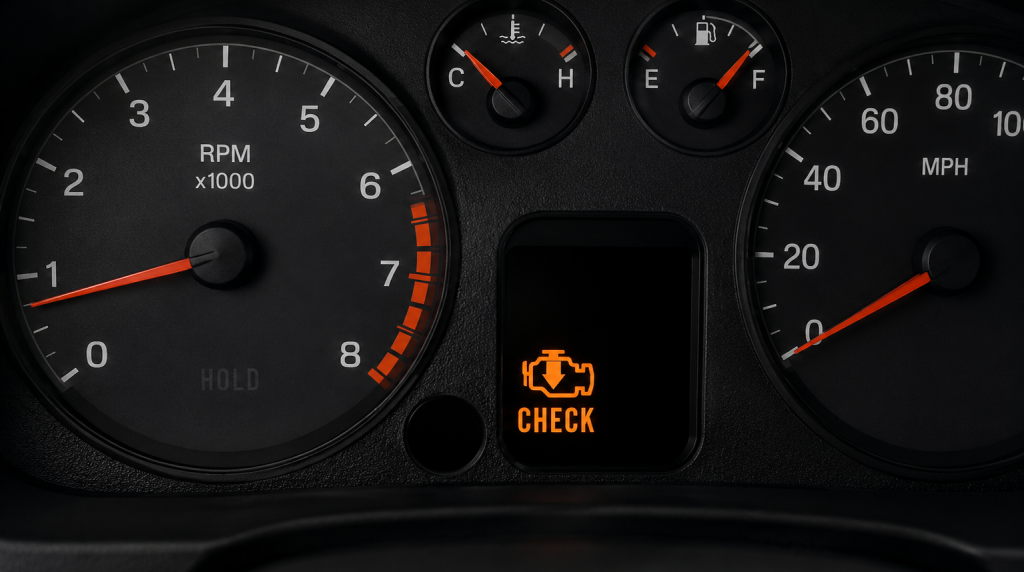
A check engine light with the down arrow icon on your dashboard is never a welcome sight, particularly if the vehicle is suddenly lagging in performance. For the majority of automobiles, that little down arrow is connected to limp mode, in which case, your automobile’s ECU (Engine Control Unit) would be limiting power delivery.
The good news is that reduced power is a protection feature, not a “your engine is instantly ruined” message. The bad news is that you should take it seriously, because continuing to drive can turn a manageable repair into a much more expensive one.
What The Down Arrow And Check Engine Light Usually Mean
If there is both a check engine light AND a down arrow indicating reduced power, this means two things:
- Your vehicle detects a problem in the system (check engine light).
- Your car limits its power output in order to avoid serious damage (down arrow).
You could notice slow acceleration, limited RPM, low throttle response, or transmission slippage. Reduced power due to transmission slipping, overheating, or any sort of electronic issues related to the transmission can also occur on certain models. This condition also causes poor gear changes.
Common Reasons Your Vehicle Goes Into Reduced Power
Reduced power can be triggered by a lot of different systems, but we most often see it tied to a few repeat offenders.
Throttle Body Or Throttle Position Sensor Issues
Modern cars have the so-called electronic throttle control system, which means that the engine cannot work efficiently if the throttle body is clogged, stuck, or the throttle position sensor works inaccurately, causing the computer to limit the throttle response and place you into reduced power mode.
Mass Airflow Sensor Or Intake Air Leaks
If the engine doesn’t get an appropriate amount of air, it won’t be able to deliver the proper fuel ratio. If there is a malfunction in the mass airflow sensor or cracks in the intake boot or intake manifold, your car would experience some issues and enter into reduced power mode.
Misfires And Ignition Problems
If there is a problem with your spark plugs, ignition coil, or fuel injector, there could be misfires, which could lead to reduced power.
Turbo Or Boost Control Problems (If Equipped)
There are numerous reasons why the turbocharged engine could go into reduced power mode, including wastegate, boost solenoid, charge pipe, underboost, and overboost issues. The computer limits output because boost is no longer operating within safe targets.
Transmission Or Drivetrain Protection Mode
Some vehicles will reduce engine power if the transmission detects slipping, overheating, or sensor faults. You might also notice harsh shifts or limited gears when this happens.
Overheating Or Cooling System Faults
A problem in this area would be if the engine is overheating or if the system detects any problems with the cooling fan, thermostat, or coolant temperature sensor. In both cases, the reduced power will come up as a measure of protection.

Can You Keep Driving With Reduced Power On?
If you are in traffic and the vehicle still drives normally enough to safely move, it is usually okay to drive carefully to a safe location. But we do not recommend “pushing through it” or continuing long distances.
Here Is How We Advise Drivers: if the car is shaking, there is a malfunction indicator light blinking, it’s overheating, makes mechanical sounds, or has difficulty accelerating – turn it off, call for a tow truck.
What You Should Do Right Away
There are several simple actions you need to take to make an informed decision about how to proceed further.
To begin with, try to figure out whether this problem was caused by acceleration, ascending the hill, while towing, or idling at a red traffic light. Next, you need to inspect your instrument panel for signs of overheating, oil pressure issues, or even battery problems. Once it seems to be stable enough, you can try restarting the ignition.
And if you happen to have a scan tool, pull the codes. Why? Because ‘reduced power’ is a symptom, not a cause. The repair can involve something as simple as cleaning the throttle body or as complex as checking the electrical systems, sensors, fuel system, or even the transmission.
How We Diagnose A Check Engine Light With A Down Arrow
Our pros at Maclane’s Automotive will address any reduced power problems promptly because they relate to the safety and drivability of your vehicle. To begin the process, we will retrieve diagnostic trouble codes, review the freeze frame data, and check the live readings from various sensors. From there, we test the system that matches the code family, instead of throwing parts at the problem.
In real-world repairs, we often find issues like carbon buildup in the throttle body, failing ignition components, intake leaks, sensor signal problems, low system voltage, or cooling system faults that trigger protection mode.
Don’t Replace Parts Based On The Warning Light Alone
It’s tempting to search for the warning and buy the most common part people mention online. The problem is that the same “reduced power” message can be caused by several different systems, and replacing parts without testing can get expensive fast.
The better approach is simple: confirm the codes, verify the failure with testing, and fix the cause the first time.
Schedule A Reduced Power Diagnosis Today
Don’t wait until your vehicle is no longer drivable when dealing with an illuminated check engine light with a down arrow warning symbol. Contact us at (484) 321-8137, and we at Maclane’s Automotive in Malvern, PA, will assist you with determining the cause, presenting your options, and restoring your car/truck’s full power.
