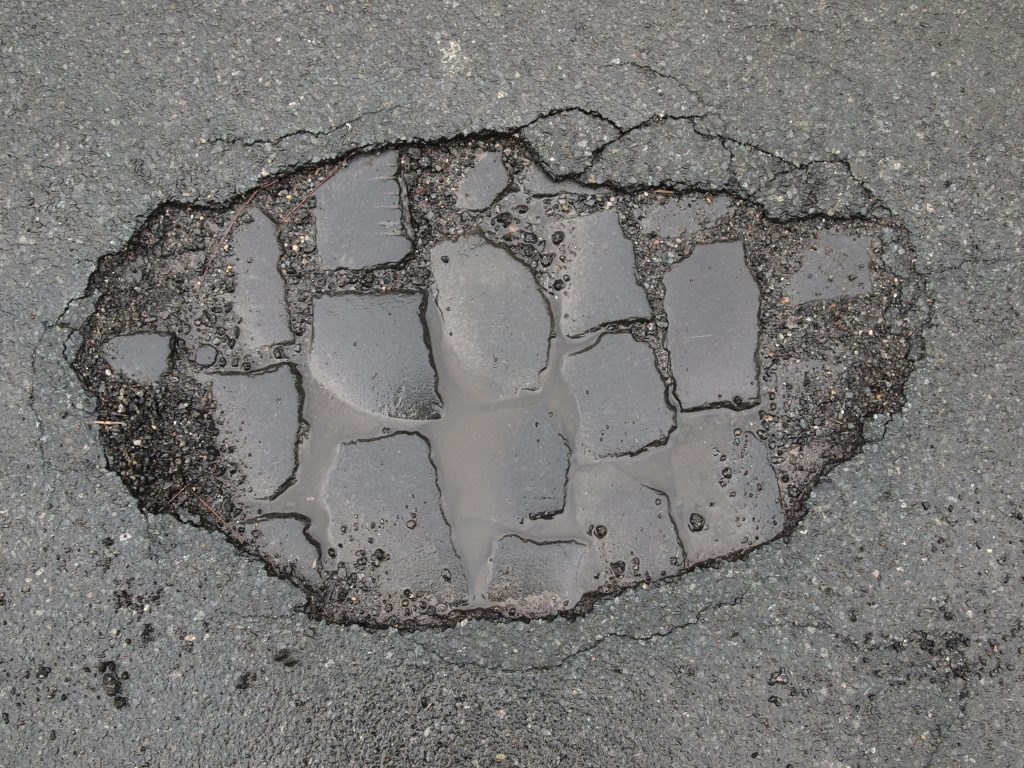
You’ve likely seen potholes in the dozens (hundreds, even!) throughout your driving life, those frustrating potholes that simply seem to pop up in the middle of your daily routine. Whether you’re talking about a little crater on your local street or one huge hole on the highway, most drivers intuitively know it’s not good for their car when they ride over these road defects.
Although most drivers are aware that potholes can damage their cars, they often do not fully understand the extent of the damage these road defects can cause. The reality is that one ride over a big pothole can start a series of mechanical problems that can cost you hundreds or thousands of dollars in repairs.
Continue reading to learn about 5 ways potholes can ruin your car’s condition. We’ll provide you with all the details you need on how potholes damage cars and why taking proper precautions against pothole damage should be a key part of your car’s maintenance schedule. Knowing about these vulnerabilities will enable you to identify signs at an early stage and take preventive steps to safeguard your investment on wheels.
1. Pothole Effect on Steering System
Your steering system is comprised of many different parts that keep your vehicle in a straight line. With every pothole you take a dive in, the force from the impact throws the parts out of alignment, causing what mechanics refer to as misaligned steering. The reason for this is that a pothole forces chaos into the equilibrium among your suspension, steering wheel, and wheels.
You will know something’s wrong when your car starts pulling in a particular direction while trying to drive straight. This pulling happens because your wheels are no longer pointed in the same direction, and you keep finding yourself making corrections just to remain in your own lane. Even the steering wheel itself will begin to look crooked when you’re driving straight down the road.
Warning signs of steering system damage include:
- Vehicle drifting left or right without input
- Crooked or off-center steering wheel position
- Squealing sounds when making turns
- Uneven tire wear patterns across the tread
The screeching on turns is because your tires are being forced to rub against the pavement at abnormally bent angles. Side-to-side tire wear occurs because areas on your tires are heavier and friction-inducing than others, causing balding or side-to-side wear on one side.
A check on your steering system immediately after driving over a big pothole prevents small misalignment issues from progressing into expensive tie rod, steering rack, or whole wheel repairs.
2. Pothole-Related Tire Damage
Your tires absorb pothole shock, making them your most vulnerable vehicle components. When you ride over a pothole, your tires undergo instantaneous and permanent compression and decompression that undermines your road safety.
Types of Tire Damage caused by Potholes
Below are the most common types of tire damage caused by potholes:
Tire punctures: They occur because sharp edges or trash contained in the pothole erode the tire surface. Nails, glass, or jagged asphalt can be hammered through by force of impact into the rubber itself, creating holes that result in a rapid loss of air.
Bulging tire sidewalls: These blown-out bulges show up when the interior tire framework is damaged. Sidewall bulge is a sign of damaged tire integrity and is a serious blowout hazard, particularly on the freeway at high speeds.
Uneven tire wear: Tread patterns will form after pothole impacts, although no outward damage can be detected during an initial visual inspection. The shock has the potential to misalign your wheels and cause uneven wear on some tread areas.
How Tire Inflation Affects Pothole Damage
Inflated tires that are not inflated enough will drastically increase pothole damage. Under-inflated tires are not structurally strong enough to absorb shock and thereby compress further onto the rim. The greater compression puts more pinch points where the tire will tend to split or tear internally.
Over-inflated tires become stiff and inflexible, making them more prone to puncture and sidewall cracking when they deform with the road.
Preventing Tire Damage from Potholes
Preserving your tires from possible damage by potholes:
Inspect your tires regularly: After hitting a pothole, check for cuts, bulges, rocks stuck in them, and uneven wear patterns.
Check tire pressure: Keep your tires at the levels that your vehicle manufacturer recommends. This is the absolute best defense against pothole damage.
Taking pre-emptive action to maintain your tires before issues arise lowers the chances of widespread damage from pothole contact.
3. Rims and Aluminum Rim Damage from Pothole Hits
Your car’s aluminum wheels suffer a pounding when you drive through a pothole, meaning they are highly susceptible to damage. Steel wheels are less stylish and heavier, but are more powerful and less likely to warp or crack while rolling into the unforgiving edge of an ugly pothole. The force of the impact from the pothole collision can cause instant visible damage in the form of dents, cracks, or bent edges to the frame of the rim.
Pothole-crinkled rims are more than mere cosmetic problems. Torn rims will not tighten correctly on your tires, leading to sluggish leaks that require frequent topping off. Bent rims also cause your vehicle to shimmy when traveling, particularly down the highway at high speeds, and your ride is uncomfortable and even unsafe.
The safety implications extend beyond comfort. Damaged rims can cause:
- Uneven tire wear that shortens tire lifespan
- Poor handling during emergency maneuvers
- Increased risk of tire separation from the rim
- Steering wheel vibration that affects control
If you’ve hit a fairly ugly pothole, don’t downplay the possibility of rim damage. Even a faint hairline crack tends to expand over time, leading to inexplicable rim failure on the road. Having your rims inspected professionally after a hard hit can catch things before they become a risk or an expense. Car repair professionals can help determine whether your rims need to be repaired or replaced so you can continue driving safely.
4. Undercarriage and Exhaust System Exposure
The subframe holds important components of your vehicle that are unseen but vital to your car’s health. When you drive into a genuinely deep pothole, the shock will extend past the damage to the surface area that it can handle, which hurts important systems underneath your car.
The exhaust system is the most vulnerable part underneath your vehicle, where parts and tubing are elevated to points that make them susceptible to pothole damage. Sharp and deep potholes punch, dent, or scratch exhaust pipes, mufflers, and catalytic converters. The ensuing exhaust pothole damage raises immediate safety and performance issues that must be addressed immediately.
Warning signs of undercarriage damage are:
- Unusual noises such as rattling, hissing, or rumbling sounds emanating from under your car
- Weird exhaust sounds or differences in engine sound
- New fluid spots found under your idling car
- Heavy exhaust gases are streaming into the cabin
- Observable damage to pipes or parts when viewed under the vehicle
If your car leaks fluids when you drive over a pothole, it may indicate a damaged oil pan, transmission components, or other critical systems. These kinds of leaks will follow a very short path from small problems to full-blown mechanical malfunctions if not addressed in time.
The reason undercarriage damage cannot be spotted is that itis crucial to have your car checked by a professional after a major hit from a pothole, as trained technicians might not identify visible damage at the time.
5. Pothole Encounter-Related Suspension System Damage
Your vehicle’s suspension system is probably the most vulnerable component when it comes to dealing with potholes on the road. This vital complex of gear – including springs, shock absorbers, and other attaching components – absorbs the impact and can be damaged outright and immediately.
Springs and shocks combine to absorb road bumps and maintain your vehicle’s level. During a hard impact into a pothole, these components may be destroyed. One hard impact may cause a flywheel spring to be wrecked or rupture a shock absorber’s internal seals, and require pothole-damaged suspension components to be replaced immediately.
The consequences of suspension damage go beyond just repair costs. You may notice:
- Excessive bouncing or swaying while driving
- Uneven ride height between different corners of your vehicle
- Difficulty maintaining control during turns or lane changes
- Overstepping distances caused by below-standard tire contact on the road
These handling problems are a grave safety issue to you and to all other users of the road. The steering response of your car is no longer reliable, and it is extremely dangerous when making emergency maneuvers or when driving in adverse weather conditions.
It is well worth getting a professional checkup after running into a pothole at high speed. Even minor suspension issues can escalate quickly, so a cheap repair can turn into an expensive one on several systems in your vehicle.
Choose Maclane’s Automotive
All of the systems we’ve talked about, from steering to suspension, are responsible for keeping you safe on the road. The idea is to detect issues in the early stages and avoid them rather than let them develop into costly repairs or hazardous driving circumstances.
Do not disregard any warning signs when you hit a pothole. Atypical sounds, pulling to one side during a turn, outside evidence of tire wear, or changes in how your car handles should all be checked out right away. Catching these issues in advance will cost you hundreds or thousands less to fix and make you a good driver.
If you’re noticing any of these signs after going over potholes, we at Maclane’s Automotive in Downingtown, PA, are ready to assist you! Our skilled technicians know exactly how pothole damage impacts your car and can offer the expert diagnosis and repairs you require.
Schedule your auto repair appointment in Downingtown, PA, today by calling (610) 590-9974. We’re dedicated to ensuring your safety on the road with top-notch repairs done correctly from the start.
